Purdue researchers develop AI model to capture protein motion, advancing drug discovery
2026-06-01
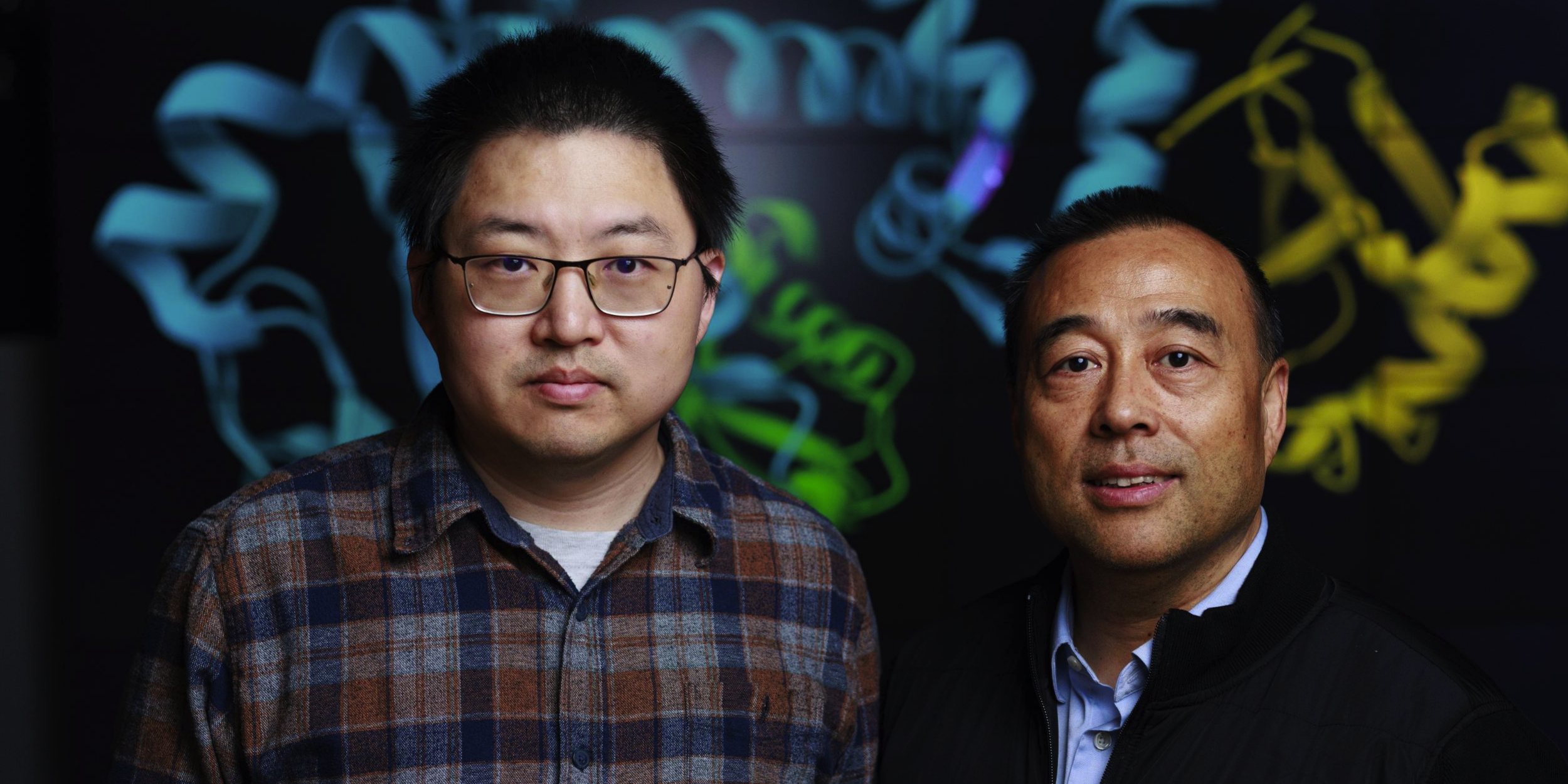
Purdue University researchers Ming Chen, left, and Guang Lin developed ProTDyn, a new AI model that predicts protein dynamics across multiple timescales, helping scientists better understand protein function and accelerate drug discovery. (Photos provided by Brian Powell)
While most artificial intelligence models in this space focus on predicting a single, static protein structure, biological reality is far more fluid. Protein function, from drug binding to enzyme activity, is driven by constant motion and rare, transient conformations.
A Purdue University research team has developed a solution to that problem. Guang Lin and Ming Chen recently published their multiscale protein dynamics model, named ProTDyn, which has been accepted as a main conference paper at the International Conference on Learning Representations (ICLR) 2026.
"At Purdue University, we developed ProTDyn, a foundation protein language model that goes beyond static snapshots," said Lin. "By learning directly from large-scale simulation data, ProTDyn captures the entire thermodynamic conformational landscape and multiscale protein dynamics."
Lin serves as Associate Dean for Research and Innovation of the College of Science, Director of Data Science Consulting Service, Co-Director of the Supply Chain AI Consortium and Moses Cobb Stevens Professor in Mathematical Sciences, Mechanical Engineering and Computer Science. He also holds courtesy professorships in Computer Science, Electrical and Computer Engineering, Statistics, and Earth, Atmospheric and Planetary Sciences. Chen is an assistant professor in the James Tarpo Jr. and Margaret Tarpo Department of Chemistry.
The implications of ProTDyn on drug discovery are wide-ranging. Traditional methods often fall short because drug candidates are tested against a single frozen structure. ProTDyn is designed to identify hidden binding pockets that only appear during specific protein motions, support modeling of induced-fit mechanisms and evaluate drug candidates across realistic conformational ensembles.
By unifying thermodynamics and physical dynamics within a single AI framework, ProTDyn enables the exploration of long-timescale dynamics that were previously too computationally expensive to access.
"We see this as a foundation for the next generation of enzyme engineering and the study of intrinsically disordered proteins, bridging the gap between data-driven machine learning and fundamental physical principles," Lin said.
“ProTDyn enables researchers to efficiently generate realistic protein conformational ensembles and dynamic trajectories across multiple timescales,” said Chen. “In drug discovery and enzyme engineering, it can help researchers better understand protein flexibility and identify functionally relevant structural states.”
About the Mathematics Department at Purdue University
The Department of Mathematics is one of seven departments making up Purdue's College of Science. The Department has an international reputation as an outstanding center for mathematical research and education. Over 70 professors are actively involved in research in many areas of mathematics, including visiting scholars and through a vibrant graduate program. The Department offers Bachelor of Science, Master of Science and Doctor of Philosophy degrees. The department is located in the Math Building at 150 N. University Street in West Lafayette, Indiana. Learn more at math.purdue.edu.
About Purdue Chemistry
The James Tarpo Jr. and Margaret Tarpo Department of Chemistry is internationally acclaimed for its excellence in chemical education and innovation, boasting two Nobel laureates in organic chemistry, the #1 ranked analytical chemistry program, and a highly successful drug discovery initiative that has generated hundreds of millions of dollars in royalties. Learn more about chem.purdue.edu.
Written by: Alison Harmeson, senior communications specialist for the Purdue University College of Science, and Guang Lin
Contributors: Guang Lin, Ming Chen
Photo by: Brian Powell