Purdue chemist Marcy Towns receives prestigious George C. Pimentel Award in Chemical Education
2026-08-31
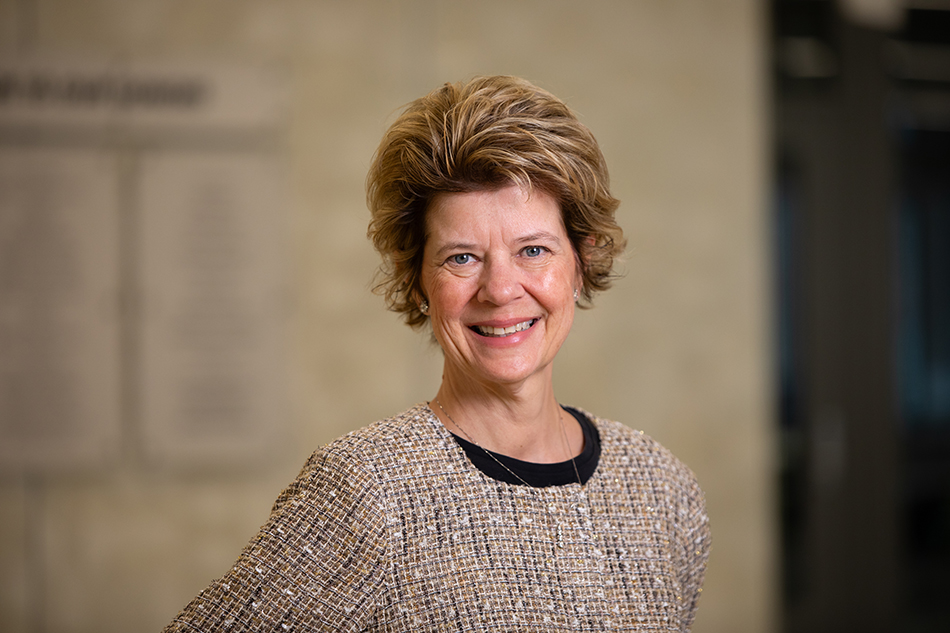
Photo by Alisha Willett/Purdue University
Marcy Towns, Purdue University College of Science Associate Dean for Leadership Excellence and Bodner-Honig Professor | Physical Chemistry, was named the recipient of the George C. Pimentel Award in Chemical Education from the American Chemical Society (ACS) on August 31, 2026. This award recognizes outstanding contributions to chemical education.
“I was completely shocked to receive it,” said Towns. “It is a very prestigious award, one with three Nobel Laureates as past recipients (Linus Pauling, Glenn T. Seaborg, and Roald Hoffmann). I am proud to continue a strong Purdue tradition of winning this award. Past recipients include Derek A. Davenport, George M. Bodner, and William R. Robinson. All three were strong mentors who deepened and broadened my scholarship and encouraged me to be engaged with the ACS.”
To be nominated for this award, a nominee must have made outstanding contributions to chemical education considered in its broadest meaning, including the training of professional chemists, the dissemination of reliable information about chemistry to prospective chemists, members of the profession, students in other fields, and the general public, or the integration of chemistry into our educational system.
“The ACS gave me a place to expand my professional network, to grow as a scholar and a professional, and to collaborate nationally and internationally,” she said. “Across nearly forty years I’ve worked on programming committees for national and international conferences, led the ACS Division of Chemical Education, and served on its boards and committees. That work that has supported scholarship and the teaching and learning of chemistry throughout my career.”
Towns said that being a member of ACS is important for a chemical student’s professional development. She said it provides a place to grow professionally through student ACS organizations, national and regional ACS meetings, and a to meet likeminded students, faculty and staff who share a passion for chemistry. Undergraduate programming at national ACS meetings includes hundreds of poster presentations allowing students to talk to chemistry faculty and staff about their research. These conversations can broaden horizons about what is possible; internships, graduate school, career paths they had not considered. It is a place to find mentors, build community, and thrive.
“Being a member of the ACS has helped to shape my career in very important ways,” said Towns. “I had strong mentors early on who were involved and engaged with the ACS and I wanted to follow in their footsteps. In the ACS I found a community that shared my passion for chemistry and a place to grow professionally.”
Towns advises current students and young professionals to build strong professional and support networks in order to grow their career in chemistry. She recommends these steps to build their foundation:
- Building a strong professional network needs to be part of your DNA, a natural habit. Start with the people around you and expand outward to professional organizations like the ACS.
- Cultivate multiple mentors, because different people help at different stages: senior mentors are invaluable for career decisions, while peers can help with practical advice about specific transitions or issues.
- Invest in your own professional development by attending professional meetings –meet people, talk about your work, find collaborators, and connect with program officers from national agencies. When asked to volunteer for a professional committee, say yes, and be consistently and professionally engaged. That is what expands your networks and leads to further opportunities.
- Be someone people can rely on: respond promptly to emails, show up to meetings having read/skimmed all the pre-reads (even if it is a 100+ page board book or agenda), and follow through on what you’ve volunteered to do or been assigned. These things will position you as a trustworthy and reliable person in the professional community.
Towns played many instrumental roles at Purdue University. Some of her favorite career memories have been taught her many lessons and she hopes this award may help share these lessons with fellow boilermakers.
“Leadership and character count,” she says. “I’ve been fortunate to work alongside colleagues and administrators who led with insight and boldness, and who never lost sight of what Purdue has been and what it can become. That was on full display when then President Mitch Daniels and former Provost Jay Akridge strongly supported hosting the 2022 Biennial Conference on Chemical Education coming out of the COVID pandemic. This conference brought 1200 chemistry faculty, staff, and graduate students to Purdue for a 5-day conference and served to reconnect and restart our chemistry community. People were hungry to reconnect personally and professionally, and Purdue provided a perfect venue to do that.”
About Purdue Chemistry
The James Tarpo Jr. and Margaret Tarpo Department of Chemistry is internationally acclaimed for its excellence in chemical education and innovation, boasting two Nobel laureates in organic chemistry, the #1 ranked analytical chemistry program, and a highly successful drug discovery initiative that has generated hundreds of millions of dollars in royalties. Learn more at chem.purdue.edu.
About the College of Science
Purdue University’s College of Science is committed to the persistent pursuit of mathematical and scientific knowledge that forms the very foundation of innovation. More than 350 tenure-track faculty conduct world-changing research and deliver a transformative education to over 6,000 undergraduates and over 1,700 graduate students. See how we develop practical solutions to today’s toughest challenges with degree programs in the life sciences, physical sciences, computational sciences, and mathematics at www.purdue.edu/science.
Written by: Cheryl Pierce, Purdue University College of Science
Contributors: Marcy Towns, Purdue University College of Science Associate Dean for Leadership Excellence and Bodner-Honig Professor | Physical Chemistry
Ali Harmeson, Purdue University College of Science Senior Communications Specialist
Photo by: Alisha Willett, Purdue University College of Science Senior Communications Specialist