Chemistry professor Jonathan Wilker selected for 2024 Grist 50, attends Climate Week in New York City
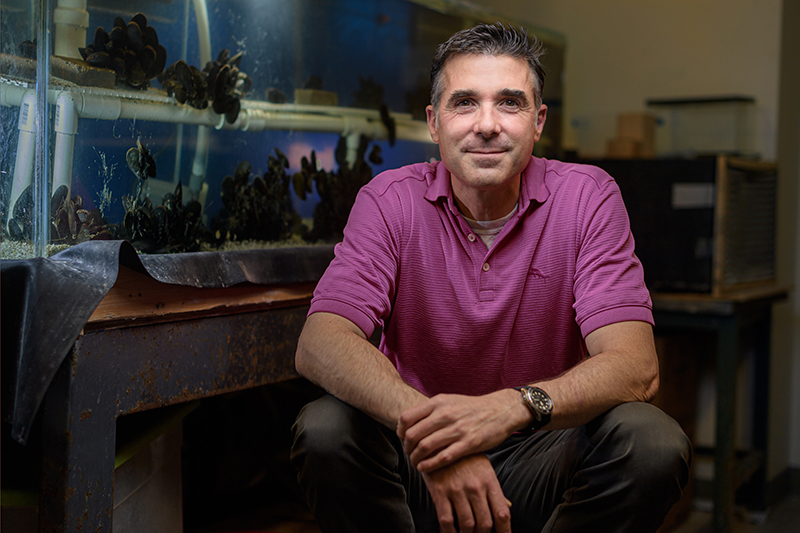
For his innovative developments in sustainable adhesives, chemist Jonathan Wilker has been named a 2024 Grist 50 Fixer. Wilker draws his inspiration from the natural world, including shellfish and oysters, mimicking these naturally sticky bonds in efforts to replace toxic, permanent, traditional adhesives. (Purdue University photo/Rebecca McElhoe)
Meet the chemist who “is putting some mussel behind sustainable adhesives.” Jonathan Wilker, a Purdue chemist, has been named to the 2024 Grist 50 Fixers alongside 49 other climate leaders from around the nation.
Grist, a nonprofit, independent media organization that focuses on climate solutions and justice, releases the annual list of Fixers from nominations across industries, selecting “50 people across the U.S. who are tackling some of the most pressing problems of today in innovative and exciting ways.” As part of the award, Wilker, a professor in the James Tarpo Jr. and Margaret Tarpo Department of Chemistry in the College of Science at Purdue University, was invited to gather in New York for a special event presented in partnership with the Clinton Global Initiative as part of Climate Week NYC.
After a highly competitive interview process, Wilker was one of only ten people chosen for the Science and Energy category for his research developing “a green substitute for the millions of tons of petroleum-based tapes and industrial chemical-based glues that stick our world together.”
For twenty-five years, Wilker and his lab have studied the science of sticky substances, analyzing marine animals like mussels and oysters that stick themselves to rocks or other organisms, to create better, more sustainable, affordable adhesives that work as well as any glue on the market.
When you visit Wilker in the Brown Laboratory building, he is quick to point out all the objects in his office that are non-recyclable and destined for landfills someday.
“Adhesives are in everything from computers and phones to furniture, carpet, shoes, building materials, and even cardboard packaging, which is rarely recycled because petroleum-based adhesives are used in the sticky backings for mailing labels,” explained Wilker, who also holds a courtesy appointment in the School of Materials Engineering.
His lab is working on high-performance adhesives made from fully sustainable agriculture feedstocks.
“We are making new bio-based adhesives that are as strong as epoxies and, ultimately, carbon-negative. Part of these efforts include creating startup companies, where we are working to find new markets for bio-based adhesives,” Wilker added.
He found participating in Climate Week to be inspiring.
“It was wonderful to see just how many people there were from arts, media, business, tech, policy, and advocacy working on these challenges. I found it heartening to hear the health equity, clean water, security, climate, and basic human rights stories being told,” said Wilker, who spent two days networking with current and past Grist 50 list members, Climate Week NYC attendees, and Clinton Global Initiative commitment makers.

Professor Jonathan Wilker attended the Clinton Global Initiative meeting in New York City on Sept. 23. (Photo courtesy of Jonathan Wilker.)

Professor Jonathan Wilker was in the audience when former President Bill Clinton presented President Joe Biden with the Clinton Global Citizen Award during the Clinton Global Initiative event in New York City on Sept. 23. (Photo courtesy of Jonathan Wilker.)
Media contact:
Steve Scherer
College of Science | Chemistry | Communications
scherer@purdue.edu
(765) 494-5204
About Purdue Chemistry
The Tarpo Department of Chemistry is internationally acclaimed for its excellence in chemical education and innovation, boasting two Nobel laureates in organic chemistry, the #1 ranked analytical chemistry program, and a highly successful drug discovery initiative that has generated hundreds of millions of dollars in royalties.
About Purdue University
Purdue University is a public research institution demonstrating excellence at scale. Ranked among top 10 public universities and with two colleges in the top four in the United States, Purdue discovers and disseminates knowledge with a quality and at a scale second to none. More than 105,000 students study at Purdue across modalities and locations, including nearly 50,000 in person on the West Lafayette campus. Committed to affordability and accessibility, Purdue’s main campus has frozen tuition 13 years in a row. See how Purdue never stops in the persistent pursuit of the next giant leap — including its first comprehensive urban campus in Indianapolis, the Mitch Daniels School of Business, Purdue Computes and the One Health initiative — at https://www.purdue.edu/president/strategic-initiatives.