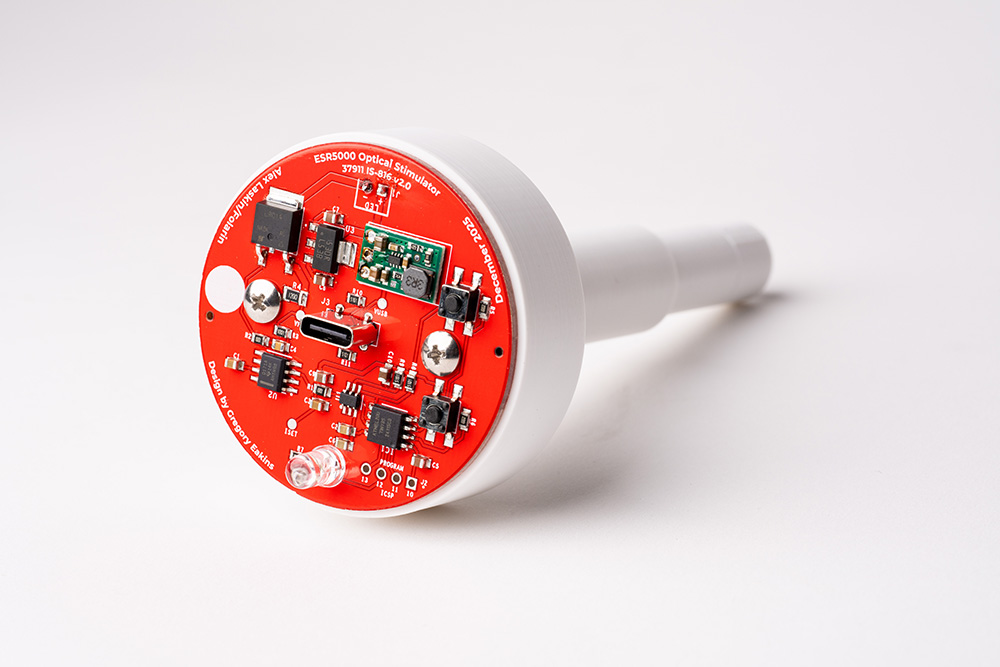
The control and drive circuitry inside of the optical stimulator. This design features a USB-C input connector for power, an ATtiny85 microcontroller for control, and a digital to analog converter for precision current control.
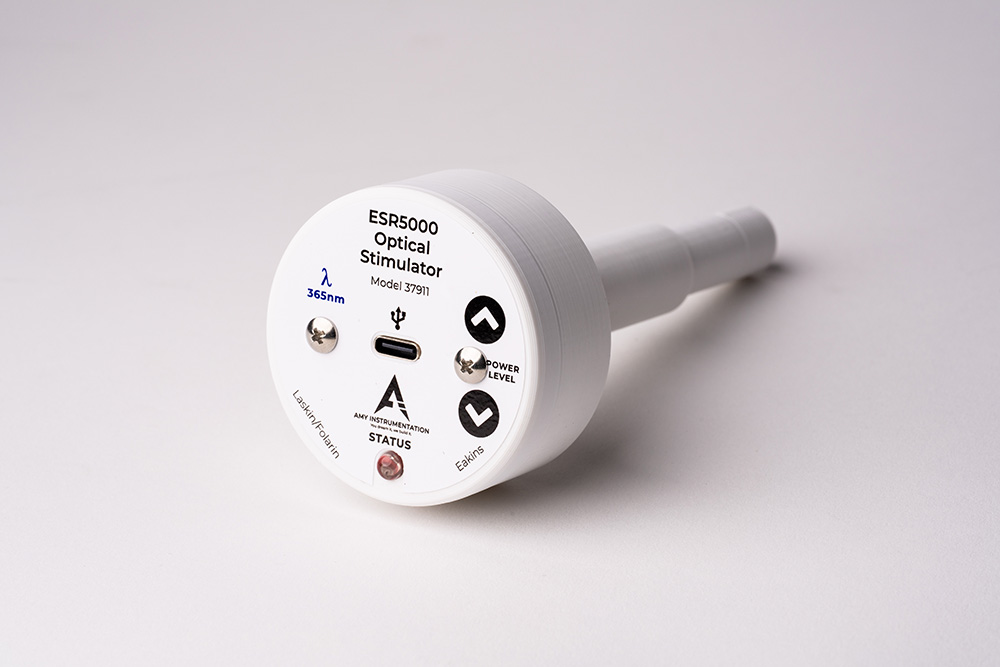
The outside of the optical stimulator. The front contains pushbutton controls to control the power level and a status indicator LED to indicate which power level the device is set to.
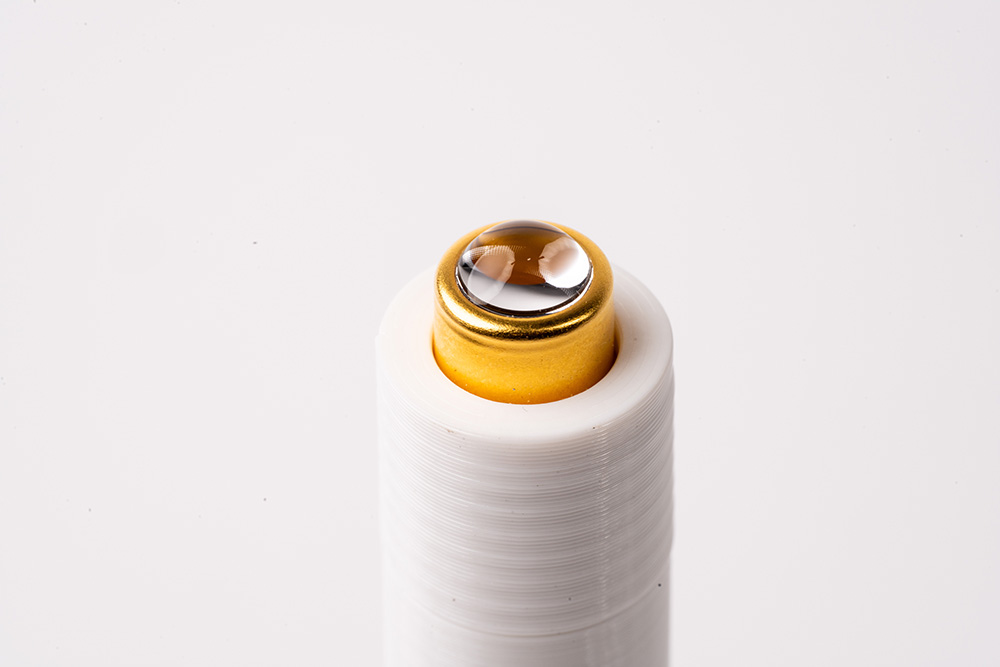
A close up of the TO package LED. A variety of LEDs in different wavelengths are available in this package, and the internal circuitry and software can be adjusted to the power level of many LEDs.
Optical Stimulator
The Laskin research group is interested in, among other topics, the photodegradation of organic materials in the environment. Exposure of these materials to UV light generates highly reactive short-lived triplet radicals. Light intensity and wavelength are critical factors affecting reactivity of these excited species. (Click here to learn more about the Laskin group’s studies characterizing radicals generated by photoexcitation of 3,4-dimethoxybenzaldehyde.) A common tool in probing the formation and reactivity of these radicals is electron paramagnetic resonance (EPR). A significant challenge in these studies is the need for an in situ light source with both wavelength and intensity control which does not involve removing either the source or sample during consecutive measurements.
The Optical Stimulator developed by the Amy Facility addresses the challenge by integrating controlled irradiation directly into the Bruker ESR5000 tabletop spectrometer. Each device provides a different wavelength and maximum power level, and 5 levels of power can be selected through a simple pushbutton interface. This allows for systematic evaluation of how light conditions influence radical formation and helps separate intrinsic sample chemistry from background photolysis. This improves experimental control, reduces variability, and provides a flexible platform for future studies on light-driven radical chemistry in chemically complex aqueous and environmental systems.
| Research Group | Alex Laskin, Chemistry |
| Lab Contact | Hannah Folarin, Chemistry |
| Amy Contact |
Greg Eakins, Chemistry |
- A Look Inside the Amy Facility
- Optical Stimulator
- Hot Plate Photoreactor
- Modular Low-Cost Photoreactor Chamber
- Pulse Stretching Amplifier
- Florescence Imaging System
- Linear Rail Fatigue Tester
- Spherical Void Electrodynamic Levitator
- Mass Spec Solids Probe
- Cold Ion Spectroscopy
- Photomultiplier Tube Power Supply
- Cryogenic Cooling Stage
- Carbon Fiber Tubing
- Coiled Tubing Reactor
- E-Beam Project
- TRAC
- Flow Reactor
- Triboluminescence
- Vertical Air Profiler
- Argos Data Collector
- ALAR
- O'Buoy Project
- Microsecond Raman imaging might probe cells, organs for disease
- High Bandwidth 16-Channel PMT Amplifier
- RCF Controller
- Photochemical Reactor
- Apple Pencil Charger
- 8-Channel RF Signal Generator